
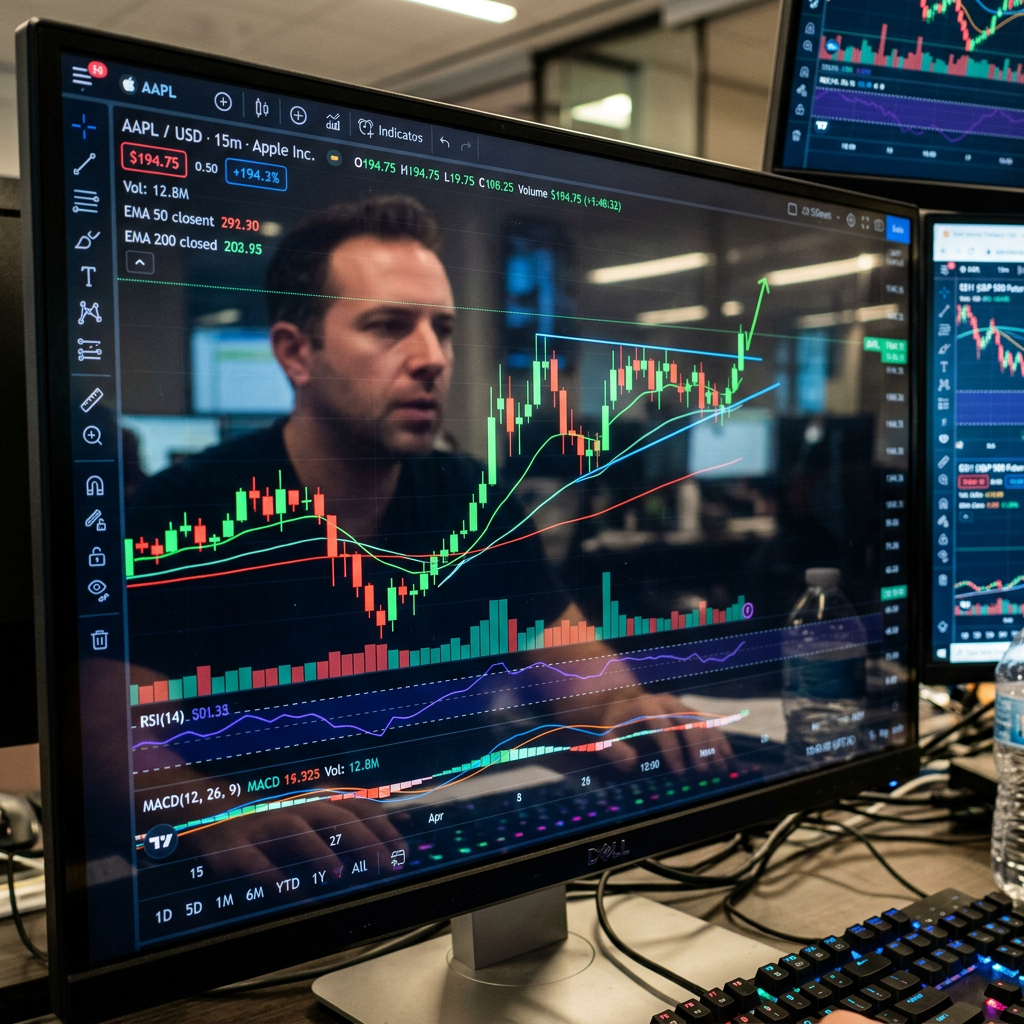
A clear-eyed primer on what it takes to enter one of the most demanding arenas in finance — before you put a single dollar at risk.
Day trading is the practice of buying and selling financial instruments — stocks, options, futures, currencies — within a single trading day, closing all positions before the market closes. Done well, it can be highly profitable. Done carelessly, it can wipe out an account in days. Most people who try it fall somewhere in between — which is why education comes first.
The allure is obvious: no boss, no commute, profit from your laptop. The reality is more rigorous. Consistent day traders combine deep market knowledge, iron discipline, a tested strategy, and exceptional risk management. This guide covers what you need to know before you begin.
70–80% of day traders lose money in the first year
$25,000 minimum equity required by FINRA PDT rule (US)
1–2% risk per trade — the professional standard
What Day Trading Actually Is
Unlike long-term investing, day trading has nothing to do with a company’s fundamentals. You’re not buying Apple because you believe in their product roadmap — you’re buying it because you believe the price will be higher in the next 20 minutes than it is right now. Positions are held for minutes or hours, never overnight.
Common instruments for day trading include individual stocks, exchange-traded funds (ETFs), stock options, futures contracts, and forex (foreign exchange) pairs. Each has its own characteristics, margin requirements, and tax treatment.
“The goal of a successful trader is to make the best trades. Money is secondary.”
— Alexander Elder, Trading for a Living
The Language of the Market
Before placing a trade, you need to understand the vocabulary. These are the essential terms every day trader uses daily:
- Bid / Ask The bid is the highest price a buyer will pay; the ask is the lowest a seller will accept. The difference is the spread — a hidden cost on every trade.
- Volume The number of shares traded in a given period. High volume confirms a move; low volume is a warning sign.
- Float The number of shares available to the public for trading. Low-float stocks tend to move faster and more violently.
- Level 2 A real-time order book showing pending buy and sell orders at various price levels. Essential for reading supply and demand.
- Stop Loss A pre-set price at which you exit a losing trade automatically. Non-negotiable for survival.
- R/R Ratio Risk-to-reward ratio. A 1:2 ratio means you risk $1 to potentially make $2. Most pros won’t take a trade below 1:2.
- PDT Rule The Pattern Day Trader rule (US) requires a $25,000 minimum balance to make more than 3 day trades in a 5-day rolling window.
Choosing Your Strategy
There is no universal “best” day trading strategy — only strategies that suit your personality, schedule, and risk tolerance. The most common approaches include:
- Momentum Trading — Riding stocks that are moving strongly in one direction on high volume, often triggered by news catalysts like earnings surprises or FDA approvals.
- Scalping — Taking many small profits throughout the day, sometimes holding a position for only seconds. Requires extreme focus and low commission costs.
- Breakout Trading — Entering when a stock breaks through a key support or resistance level, betting the move will continue.
- Reversal Trading — Identifying when an extended move is exhausted and positioning for a reversal. Higher risk, higher reward.
- Gap and Go — Trading stocks that open significantly higher or lower than the previous day’s close, typically due to overnight news.
New traders are advised to master one strategy completely before adding others. Depth beats breadth in the early stages.
The Non-Negotiables of Risk Management
If there is one thing that separates traders who survive from those who don’t, it is risk management. No strategy wins every trade — the question is whether your winners are large enough to cover your losers.
- Never risk more than 1–2% of your total account on a single trade.
- Set your stop loss before you enter — not while a trade is moving against you.
- Honor your stop loss every single time. Moving it is how small losses become catastrophic ones.
- Track every trade in a journal: entry, exit, P&L, and why you took it.
- Define a daily loss limit (e.g., 3% of account). Hit it — stop trading for the day.
- Size positions based on your stop loss distance, not on intuition.
The Tools You’ll Need
Successful day trading requires more than a brokerage app. Professional traders use specialized platforms that provide speed, data, and control that consumer apps can’t match.
- A Direct-Access Broker — Platforms like Interactive Brokers, Tastytrade, or TradeStation route orders directly to exchanges for faster execution and better fills.
- Real-Time Charts — TradingView, ThinkOrSwim (TD Ameritrade), or DAS Trader for charting with technical indicators.
- A Stock Scanner — Tools like Finviz, Trade Ideas, or the built-in scanner on your platform help you find stocks with unusual volume, momentum, or catalyst activity.
- Level 2 Quotes — Seeing the full order book, not just the last trade price. Most professional platforms include this.
- A Trade Journal — Spreadsheet or dedicated software (Tradervue, TraderSync) to log and analyze every trade.
Paper Trading First
Most serious brokers and platforms offer paper trading — simulated trading with fake money but real market data. Every beginner should spend at minimum 60–90 days paper trading before touching real capital. This is not optional. You are learning to manage your psychology as much as your strategy, and you cannot simulate that adequately in your head.
When your paper trading results are consistently positive across at least 50–100 simulated trades, consider starting with a small real account — not your life savings.
Day trading involves substantial risk of loss and is not appropriate for all investors. The majority of retail day traders lose money. This article is for educational purposes only and does not constitute financial or investment advice. Always consult a licensed financial professional before trading with real capital.
The Psychological Edge
Markets are driven by fear and greed — and so are traders. The biggest edge you can develop isn’t a better indicator; it’s emotional discipline. FOMO (fear of missing out) causes overtrading. Revenge trading after a loss causes blowups. Overconfidence after a winning streak causes recklessness.
Treat trading like a business. Follow your written trading plan. Take breaks. Accept that losses are a cost of doing business — what matters is your edge over hundreds of trades, not the outcome of any single one.
The traders who last aren’t the ones who take the biggest risks — they’re the ones who protect their capital long enough to get good at this. Start slow, study obsessively, and let your results — not your emotions — guide your progress.
For educational purposes only · Not financial advice · Past performance does not guarantee future results
Leave a Reply